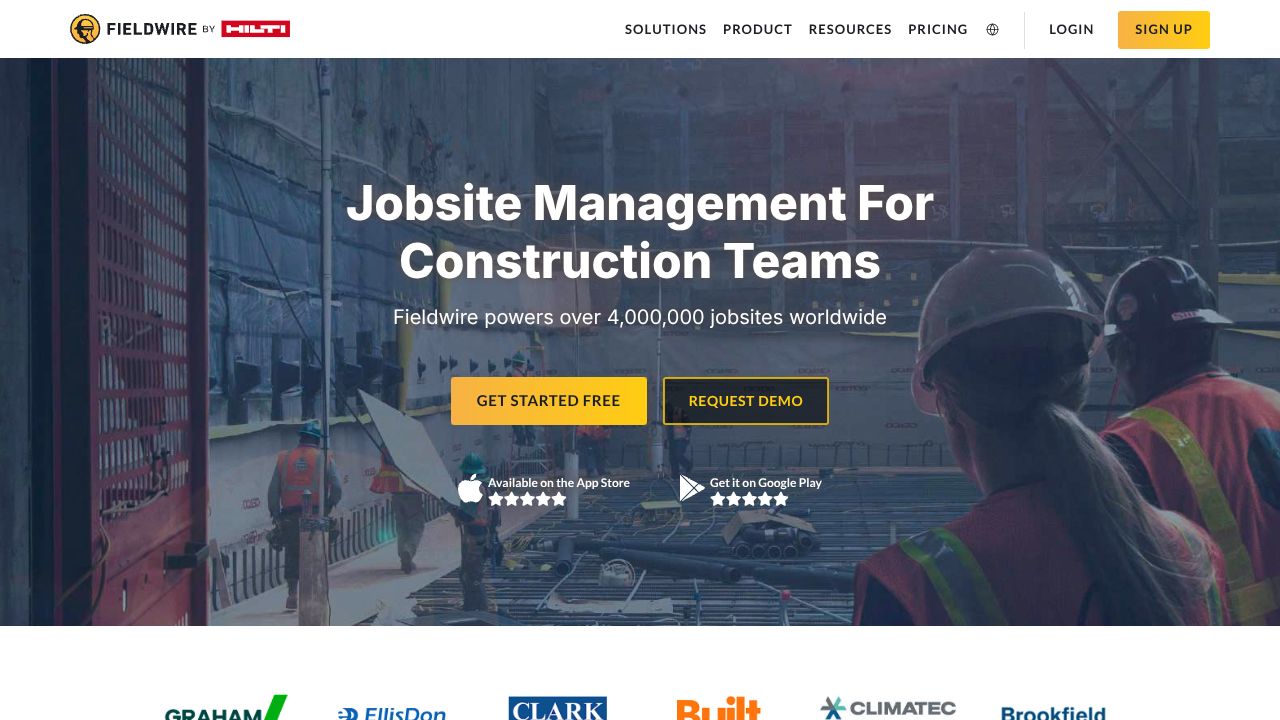
Ever spent hours staring at a blueprint only to realize your field crew is working off an outdated version three floors below you?
In my 15 years navigating the intersection of hardware and heavy industry, I’ve seen more startups fail due to "communication drift" than bad engineering. Fieldwire entered the market to solve exactly that—bridging the gap between the air-conditioned trailer and the dusty job site. But as the Task Management space for construction matures, the "one-size-fits-all" approach is dying. Today, choosing the right vector for your growth means knowing whether you need a broad platform or a laser-focused specialist.
↗ The Construction Tech Chessboard: Fieldwire vs. The Field
| Feature | Fieldwire | Buildup |
|---|---|---|
| Core Strength | Blueprint-centric tasking | Punch list & inspections |
| Pricing | Tiered (Free to Elite) | Quote-based / Enterprise |
| Ease of Use | High (Mobile-first) | High (Simplified UI) |
| Startup Fit | Scalable for small teams | Best for mid-to-large residential |
| Offline Mode | Robust sync | Strong field-to-office sync |
↗ Where Fieldwire Commands the Site
In the startup world, we talk a lot about "single sources of truth." Fieldwire’s primary advantage is that it treats the blueprint as that source.
- →Plan-Centric Tasking: Unlike general task managers, Fieldwire allows you to pin tasks directly to specific coordinates on a PDF plan. While Buildup is exceptional at managing the sheer volume of a punch list, Fieldwire’s spatial orientation is a game-changer for MEP (Mechanical, Electrical, and Plumbing) startups that need exact location data.
- →Version Control Authority: I’ve seen projects lose six figures because of a misaligned revision. Fieldwire’s ability to automatically sync markups across all mobile devices ensures the "magnitude" of your team’s effort isn't wasted on the wrong wall.
- →The "Freemium" On-Ramp: For a lean startup, Fieldwire’s free tier for small teams is a massive strategic advantage. It allows you to prove the ROI to stakeholders before committing to a heavy enterprise contract—a flexibility that more rigid platforms often lack.
↗ Where the Competition Sharpens the Edge
Fieldwire is a powerhouse, but it isn't the only vector in the market. Depending on your specific niche, you might find its breadth a bit overwhelming.
- →Punch List Specialization: If your startup is focused heavily on the "handover" phase or high-volume residential projects, you might find Fieldwire’s interface a bit cluttered for rapid-fire inspections. This is where Buildup often takes the lead. Buildup is designed with a specific focus on streamlining communication between developers, general contractors, and subcontractors, often making the close-out process feel more intuitive than Fieldwire’s broader project management approach.
- →Workflow Rigidity: Fieldwire is incredibly flexible, which is a double-edged sword. For teams that want a "prescriptive" workflow—meaning the software tells you exactly what step comes next—Buildup provides a more structured environment that can reduce human error during the critical final 10% of a project.
↗ Strategic Selection: Best Use Cases for Startups
Choosing your stack is about identifying your primary "Growth Vector."
- →Choose Fieldwire if: You are a specialty contractor or a tech-heavy construction startup that needs a 360-degree view of the project. If your work relies on constant plan references and complex coordination between different trades, Fieldwire’s robust document management is your best bet.
- →Choose Buildup if: You are focused on multi-family residential or large-scale developments where the "punching" process is the primary bottleneck. If your goal is to minimize the friction of subcontractor communication and accelerate the move-in date, the specialized tools in Buildup will likely serve you better.
↗ The Editor’s Verdict
From my perspective, Fieldwire remains the "direction setter" for the industry because of its versatility. It’s the Swiss Army knife that actually stays sharp. However, as an editor and strategist, I always tell founders: don't buy more features than you can execute.
If you are a lean outfit looking to dominate the final stages of construction with surgical precision, the streamlined nature of Buildup might actually give you more velocity. But if you need a platform that grows from the first shovel in the ground to the final walkthrough, Fieldwire’s blueprint-first philosophy is hard to beat. Choose the tool that matches your team's current magnitude, not your five-year ego.
EXTERNAL VECTOR
VISIT FIELDWIRE ↗