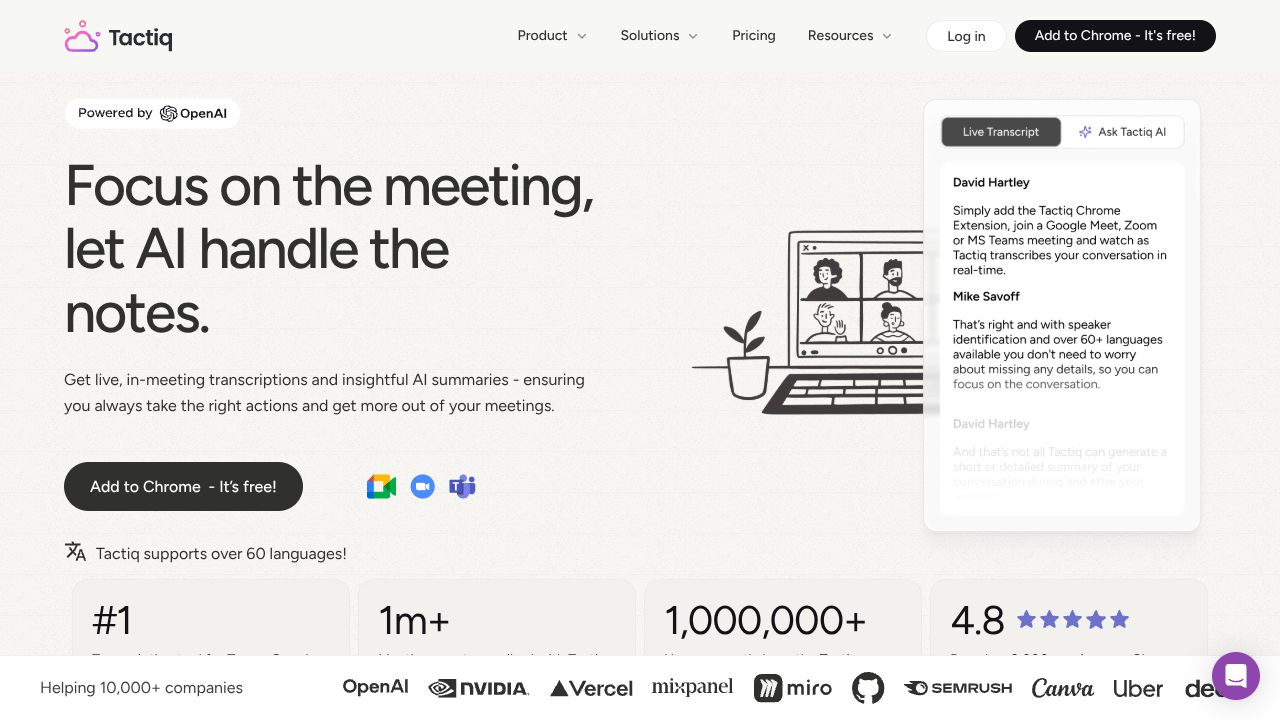
In the next five minutes, you will learn how to transform your organization’s ephemeral meeting data into a permanent, searchable asset that drives execution. Tactiq bridges the gap between high-level strategic discussion and tactical follow-through by providing real-time transcription for Google Meet and Zoom without the intrusion of a "bot" participant. For founders, this means capturing every pivot and product requirement with zero friction, ensuring that the "magnitude" of your team’s effort is always aligned with the right "direction."
↗ Capturing the Invisible Architecture of Your Startup
In my 15 years navigating the tech landscape, I’ve seen more startups fail due to "information leakage" than lack of capital. When a founder’s vision is diluted through three layers of management because the original context of a Zoom call was lost, velocity drops. Tactiq positions itself as the silent observer of your strategic engine. Unlike traditional transcription services that require you to upload a file after the fact, Tactiq lives in the browser, capturing insights as they happen.
The business case for Tactiq isn't just about "taking notes"; it’s about institutional memory. For a scaling venture, the ability to instantly search through six months of stakeholder interviews or technical sprints is a massive competitive advantage. While tools like Rev are the gold standard for high-fidelity, human-verified archives, Tactiq is built for the high-velocity, day-to-day internal communications where speed and real-time integration outweigh the need for 99.9% grammatical perfection. It turns every conversation into a structured data set that can be pushed to your CRM or project management stack immediately.
↗ Key Strategic Benefits
- →Operational Efficiency: Tactiq eliminates the "meeting after the meeting" by generating instant summaries and action items. By automating the documentation process, your lead engineers and product managers can focus on the dialogue rather than transcribing requirements, reducing the administrative burden by hours per week.
- →Cost Impact: The ROI is realized through the elimination of redundant meetings and the reduction of specialized transcription costs. By utilizing AI-driven real-time capture, you bypass the per-minute fees associated with premium services like Rev, making it a more sustainable choice for high-volume internal syncs.
- →Scalability: As your headcount grows, the "founder’s intent" often gets lost. Tactiq allows for a centralized repository of transcripts that serves as an onboarding goldmine, allowing new hires to "listen in" on historical context and decision-making processes without requiring synchronous time from leadership.
- →Risk Factors: The primary risk is data privacy and the "panopticon effect." Leaders must establish clear transparency protocols regarding when recording is active to maintain psychological safety within the team, ensuring that the tool encourages rather than stifles open debate.
↗ Navigating the Implementation Curve
Adopting Tactiq is a low-friction maneuver because it functions as a browser extension rather than a complex enterprise integration. However, for a startup leader, the challenge isn't the software installation—it’s the change management. You must define where this data lives. Does it feed into your Notion workspace? Does it trigger Jira tickets?
From what I’ve seen, the most successful implementations involve a 30-day "transparency sprint" where leadership models the behavior by sharing their own meeting summaries. Integration with your existing stack is vital; if the transcripts sit in a silo, they are useless. You need to treat your conversation data with the same rigor that Fonn treats construction documentation—as a single source of truth that prevents costly rework and ensures every stakeholder is operating from the same blueprint.
↗ The Competitive Landscape: Context is King
When evaluating the communication stack, it’s essential to recognize that "transcription" is not a monolith. If your startup is in a niche like heavy industry or construction, you might find that Fonn provides a more specialized communication framework specifically designed for site-to-office documentation and project workflows.
For marketing teams focused on content creation, Happy Scribe offers a superior interface for subtitle editing and multi-language support, which is often a better fit for external-facing media than Tactiq’s internal-productivity focus. Similarly, if you are preparing a legal filing or a high-stakes board presentation, the human-in-the-loop accuracy of Rev remains the benchmark. Tactiq wins, however, in the "flow of work." It is the only tool that truly feels invisible during the meeting, making it the superior choice for founders who want the benefits of AI transcription without the awkwardness of a virtual "recorder" bot sitting in the call.
↗ Editor’s Recommendation
If your team is currently losing more than three hours a week to manual documentation or "re-syncing" on previous decisions, Tactiq is a non-negotiable addition to your stack. Start by deploying it within your Product and Engineering teams for a two-week trial. Focus on the Slack/Notion integration to ensure notes are surfaced where work actually happens. Stop letting your best ideas evaporate the moment you click "End Meeting." Capture the magnitude; set the direction.
EXTERNAL VECTOR
VISIT TACTIQ ↗